
Safeguarding Children and Adults at Risk Policy and Procedures
Policy Statement
This policy outlines Jamma Wellbeing’s approach to recruiting people to work with children, young people and vulnerable adults in England and Wales. It sets out how we ensure everyone connected with our Organisation knows, understands and is kept up to date with safeguarding legislation and best practice.
It covers how we respond internally and work with external stakeholders, agencies and partners to respond to any safeguarding concerns or potential concerns.
Jamma Wellbeing is committed to equality of opportunity for all job applicants and aim to select people for employment based on their skills, abilities, experience, knowledge and, where needed, qualifications and training.
We will comply with our legal obligations when recruiting people to work with children, young people and vulnerable adults.
Revision History
This policy applies to positions to work with children, young people and vulnerable adults in England and Wales. It will be reviewed and updated whenever required.
This policy and related guidance therein will be monitored by one of the Organisation’s DSL for compliance and an annual review by DSLs will be conducted. There will also be an annual update on Level 3 DSL qualification.
Date approved or amended | Amendments | Signed |
|
|
|
1. Purpose
1.1. This policy defines how Jamma Wellbeing operates to safeguard children, young people and vulnerable adults at risk of abuse or neglect.
1.2. We have a duty of care and are committed to the protection and safety of children, young people and vulnerable adults involved as visitors and as participants in all of our activities.
1.3. We also have a duty to protect and support our Trustees, employees, volunteers and contractors who work or come into contact with these groups.
2. Definitions
2.1. Children and young people are defined as those aged under 18 years old (under 25 years old for young people with SEN).
2.2. “Safeguarding and promoting the welfare of children” is defined in Working Together 2015 as:
2.2.1. protecting children from maltreatment
2.2.2. preventing impairment of children’s health and development
2.2.3. ensuring that children grow up in circumstances consistent with the provision of safe and effective care
2.2.4. taking action to enable all children to have the best outcomes
2.3. Vulnerable adults are defined as those at risk of abuse or neglect and refers to someone over 18 years old who, according to paragraph 14.2 of the Care Act 2015:
2.3.1. has care and support needs
2.3.2. is experiencing, or is at risk of, abuse or neglect
2.3.3. as a result of their care and support needs is unable to protect himself or herself against the abuse or neglect or the risk of it
2.4. If someone has care and support needs but is not currently receiving care or support from a health or care service, they may still be an adult at risk
3. Persons affected
3.1. This policy applies to all relevant individuals which includes, but is not limited:
3.1.1. Parents, carers, Trustees, employees, educationalists, and volunteers
3.1.2. All service users (e.g. children, young people and vulnerable adults)
3.1.3. All visitors, contractors and subcontractors.
4. Types of Abuse
4.1. Abuse is a violation of a person’s human and civil rights by any other person. It is where someone does something to another person, or to themselves, which puts them at risk of harm and impacts on their health and wellbeing.
4.1.1. It can happen to any individual regardless of age, circumstance or capability.
4.2. Abuse comes in many forms and can often have a damaging effect on the health and wellbeing of an individual; the effects may be short term or may last a long time. The signs of abuse aren’t always obvious, and the victim may not tell anyone what is happening to them – sometimes they may not even be aware they are being abused.
4.2.1. The list in Appendix 4 (entitled “RECOGNISING TYPES AND SIGNS OF POSSIBLE CHILD, YOUNG PERSON OR VULNERABLE ADULT ABUSE”) sets out the different types of abuse and what signs you might look for if someone is experiencing such abuse.
4.3. Jamma Wellbeing has a zero-tolerance approach to abuse. We recognise that under the Care Act 2014 we have a duty for the care and protection of vulnerable adults who are at risk of abuse and also recognise our responsibilities for the safety and care of children under the Children Act 1989 and 2004.
4.4. We are committed to promoting wellbeing, harm prevention and to responding effectively if concerns are raised in conjunction with the appropriate organisations, authorities and service providers to ensure swift and personalised safeguarding responses.
4.5. We are also committed to inter-agency collaboration on the development and implementation of procedures for the protection from abuse of children, young people and vulnerable adults, and have a duty and responsibility for making arrangements to ensure all functions and duties are discharged having regard to safeguarding.
4.6. There can be no excuses for not taking all reasonable action to protect children, young people and vulnerable adults at risk of abuse, exploitation, radicalisation and mistreatment.
4.6.1. All citizens of the United Kingdom have their rights enshrined within the Human Rights Act 1998. People who are eligible to receive health and community care services may be additionally vulnerable to the violation of these rights by reason of disability, impairment, age or illness.
4.7. Please refer to local and national multi-agency safeguarding partnerships, pathways and guidance for further information.
5. Six key principles that underpin safeguarding adults work:
5.1. Empowerment – People supported and encouraged to make their own decisions and informed consent.
5.2. Prevention – It is better to act before harm occurs.
5.3. Proportionality – The least intrusive response appropriate to the risk presented.
5.4. Protection – Support and representation for those in greatest need.
5.5. Partnership – Local solutions through services working with their communities. Communities have a part to play in preventing, detecting and reporting abuse.
5.6. Accountability – accountability and transparency in delivering safeguarding.
6. Making Safeguarding Personal
6.1. Making Safeguarding Personal is a shift in culture and practice in response to what we now know about what makes safeguarding more or less effective from the perspective of the person being safeguarded. It is about seeing people as experts in their own lives and working alongside them in a way that is consistent with their rights and capacity and that prevents abuse occurring wherever possible.
6.2. Safeguarding should be person-led and outcome focused, engaging the individual at risk in a conversation about how best to respond to their safeguarding situation in a way that enhances involvement, choice and control as well as improving quality of life, wellbeing and safety.
6.2.1. In most cases this can only happen by making sure individuals get the care and support that they need. It is also important that those who care for them also get this support and recognition. Most importantly it is about listening and providing the options that permit individuals to help themselves.
6.3. It is also important that all safeguarding partners take a broad community approach to establishing safeguarding arrangements.
6.3.1. It is vital that all organisations recognise that Safeguarding Adults arrangements are there to protect individuals, bearing in mind different preferences, histories, circumstances and lifestyles.
6.4. In order to evidence that the Safeguarding process is personalised, it is necessary to collect information about the extent to which this shift has a positive impact on people’s lives.
6.5. Whilst every effort must be made to work with vulnerable adults experiencing abuse within the present legal framework there will be some occasions on which adults at risk will choose to remain in dangerous situations.
6.5.1. It may be that even after careful scrutiny of the legal framework, representatives of Jamma Wellbeing will conclude that they have no power to gain access to a particular adult at risk. Employees may find that they have no power to remove the adult from a situation of risk, investigate the adult’s financial affairs, or intervene positively because the adult refuses all help or wants to terminate contact with the professionals.
6.6. It may not always be possible to provide satisfactory solutions. At the age of 18, people are legally entitled to adult status regardless of any disability or impairment they may have.
6.7. It is therefore essential that wherever possible it is the adult at risk who will decide on the chosen course of action, taking into account the impact of the adult at risk’s mental capacity where relevant. However, the people and organisations caring for, or assisting them, must do everything they can to identify and prevent abuse happening wherever possible and evidence their efforts.
6.8. In these extremely difficult circumstances, employees will be expected to continue to exercise as much vigilance as possible.
6.9. Jamma Wellbeing’s Designated Safeguarding Leads (DSL) will give full support to employees over problems when handling cases of adults remaining in high-risk situations, provided that:
6.9.1. It is evident from case records that Safeguarding Adults procedures have been properly followed
6.9.2. Every effort has been made, on a multi-agency basis, to intervene positively to protect the adult at risk
6.9.3. Legal advice has been obtained and acted upon; and
6.9.4. ultimately that the adult at risk has been fully consulted and involved as far as practicable in every decision relating to their situation.
6.10. Jamma Wellbeing is committed to the following principles:
6.10.1. the welfare of the child, young person or adult at risk is paramount
6.10.2. all children, young people and adults at risk have the right to protection from abuse, safeguarding is everyone’s responsibility: for services to be effective each professional and organisation should play their full part; and
6.10.3. all suspicions and allegations of abuse must be properly reported to the relevant internal and external authorities and dealt with swiftly and appropriately
6.10.4. arrangements which set out clearly the processes for sharing information procedures with other professionals and with the Local Safeguarding Children Board (LSCB) and Safeguarding Adult Board
6.10.5. employees, contractors and volunteers must be clear on appropriate behaviour and responses.
6.10.5.1. Refer to Appendix 1 for the Organisation’s Safeguarding Code of Conduct.
6.10.5.2. Where appropriate, failure by employees to maintain standards may be dealt with using Jamma Wellbeing’s internal Disciplinary Procedures
6.10.6. whistleblowing policy and procedures are suitably referenced in employees’ training and codes of conduct, and a culture that enables issues about safeguarding and promoting welfare to be addressed
6.10.7. employees are made aware of the policy and procedures for the protection of children, young people and adults at risk through appropriate safeguarding training, supervision and support available for employees which creates an environment where employees feel able to raise concerns and feel supported in meeting their safeguarding role
6.10.8. employees are given a mandatory induction, which includes familiarisation with safeguarding responsibilities and procedures to be followed if anyone has any concerns
6.10.9. employees should have regular reviews of their own practice to ensure they improve over time in their work with children, young people, vulnerable adults and families
6.10.10. a clear line of accountability for the provision of safe services exists
6.10.11. a Trustee Board level lead to take leadership responsibility for Jamma Wellbeing’s safeguarding arrangements
6.10.12. designated leads for safeguarding at Jamma Wellbeing
6.10.13. safe recruitment practices are in place including policies on when to obtain an Enhanced DBS check
6.10.14. clear policies in line with those from the Local Safeguarding Children Boards (LSCBs) for dealing with allegations against people who work with children.
6.10.14.1. Such policies should make a clear distinction between an allegation, a concern about the quality of care or practice or a complaint; an allegation may relate to a person who works with children who has:
6.10.14.1.1. behaved in a way that has harmed a child, or may have harmed a child
6.10.14.1.2. possibly committed a criminal offence against or related to a child, or
6.10.14.1.3. behaved towards a child or children in a way that indicates they may pose a risk of harm to children.
6.11. Jamma Wellbeing will ensure that Trustees, employees, volunteers and contractors understand core legal safeguarding requirements and their responsibility to keep children, young people and vulnerable adults at risk safe and that everyone who comes into contact with children, young people and vulnerable adults are alert to the needs of those groups and any risks of harm that individual abusers, or potential abusers, may pose.
6.12. The requirement to share appropriate information in a timely way and can discuss any concerns about an individual child with colleagues, one of the Organisation’s DSLs and local authority children’s and adult’s social care
7. Capacity, Consent and Decision Making
7.1. The consideration of capacity is crucial at all stages of Safeguarding Adults procedures. For example, determining the ability of an adult at risk to make lifestyle choices, such as choosing to remain in a situation where they risk abuse; determining whether a particular act or transaction is abusive or consensual; or determining how much an adult at risk can be involved in making decisions in a given situation.
7.2. The key development affecting this area of work is the implementation of the Mental Capacity Act 2005, which provides a statutory framework to empower and protect adults at risk who may not be able to make their own decisions. It makes it clear who can take decisions in which situations and how they should go about this. It enables people to plan ahead for a time when they may lose capacity. It applies to anyone aged 16 years and over therefore appropriate liaison needs to occur for young people aged 16 to 18 years with Children’s Services where relevant as part of Safeguarding Adults work.
7.3. The whole Act is underpinned by a set of five key principles:
7.3.1. A presumption of capacity – every adult has the right to make his or her own decisions and must be assumed to have capacity to do so unless it is proved otherwise;
7.3.2. The right for individuals to be supported to make their own decisions – people must be given all appropriate help before anyone concludes that they cannot make their own decisions;
7.3.3. That individuals must retain the right to make what might be seen as eccentric or unwise decisions;
7.3.4. Best interests – anything done for or on behalf of people without capacity must be in their best interests; and
7.3.5. Least restrictive intervention – anything done for or on behalf of people without capacity should be the least restrictive of their basic rights and freedoms.
7.3.6. Please refer to relevant regional Safeguarding Adult Board for further guidance.
8. Types of Disclosure and Barring Service check
8.1. There are four types of Disclosure and Barring Service (DBS) checks:
8.1.1. Basic disclosure: Shows details of unspent convictions only.
8.1.2. Standard disclosure: Shows details of spent convictions, unspent convictions and cautions that have not been filtered.
8.1.3. Enhanced disclosure: Shows details of spent convictions, unspent convictions and cautions that have not been filtered. Includes a check of local police records.
8.1.4. Enhanced disclosure with barred lists check: Shows details of spent convictions, unspent convictions and cautions that have not been filtered. Includes a check of local police records and the barred lists held by the DBS.
9. Disclosure of criminal convictions
9.1. All job applicants of Jamma Wellbeing are required to disclose all criminal convictions, whether spent or unspent (other than where protected cautions and protected convictions do not need to be disclosed, depending on the job concerned).
10. DBS checks and Eligibility
10.1. All job applicants will be required to consent to apply via a Responsible Organisation for an Enhanced disclosure, showing details of unspent criminal convictions.
10.1.1. Employees and volunteers may be asked to consent to an Enhanced DBS check during any point in their employment, if their role deems it appropriate.
11. Process for DBS checks
11.1. To enable job applicants for posts covered by this policy to carry out the DBS check (other than where a basic disclosure only is required), Jamma Wellbeing will provide them with an application form and ask them to complete and return the form to us along with documents proving their identity.
11.2. Jamma Wellbeing will send the completed form to the DBS together with the application fee. Once the check has been carried out, the DBS should send the certificate to the job applicant. We will ask the job applicant for sight of the DBS certificate.
11.3. If the job applicant is a member of the DBS update service, Jamma Wellbeing will, with their consent, conduct a status check on any current certificate.
12. Offers of employment
12.1. An offer of employment or contracting for a post involving work with children, young people and/or vulnerable adults will be conditional on the job applicant satisfying our usual requirements for employment (e.g. provision of satisfactory references and evidence establishing their right to work in the UK).
12.2. Additionally, our offer of employment will be conditional, where required, on satisfactory completion of relevant DBS check, depending on the post in question.
12.3. In the event that a job applicant refuses to agree to an application to the DBS, or a DBS check is completed but they refuse to allow us to see the DBS certificate, the job applicant will be treated as not having satisfactorily completed the DBS check and the offer of employment may be withdrawn.
12.4. Job applicants and contractors will not, without exception, be permitted to commence employment with our organisation until all specified conditions are satisfied.
12.5. Not all criminal convictions will be a bar to employment. We will consider the results of a DBS check on an individual basis and will act in a proportionate manner when deciding whether to proceed with an appointment to the post in question. However, the protection and safeguarding of children, young people and vulnerable adults is our primary concern.
13. Safeguarding Procedures
13.1. The responsibilities for dealing with safeguarding lie with the following:
13.1.1. Safeguarding is everyone’s responsibility; everyone associated with the Organisation (paid and unpaid) are required to report any suspected abuse and be aware of the appropriate reporting and support procedure for safeguarding.
13.1.2. It is important that Trustees, employees, volunteers and contractors are also aware of the Government’s PREVENT strategy the aim of which is to stop people becoming terrorists or supporting violent extremism in all its forms.
13.1.2.1. This can also be a safeguarding issue but follows different reporting mechanisms.
13.1.3. The DSLs will discharge their safeguarding functions in a way that ensures that children, young people and vulnerable adults are safeguarded from harm and promotes their welfare.
13.1.3.1. They are responsible for following up any suspected reports of abuse and for informing the Police or other appropriate external bodies.
13.1.4. The Trustee Board is responsible for overall supervision of these activities.
14. Reporting of Safeguarding Concerns
14.1. If there is a safeguarding concern about a child, young person or vulnerable adult, it should be reported in the first instance with the Organisation’s DSLs via 01483-958052 which is a monitored number to discuss your concerns at the earliest opportunity, as long as it will not delay any potential referral or place someone at harm. The initial call should be followed up via email (info@jammawellbeing.com) to ensure it is documented.
15. Designated Safeguarding Leads (DSL)
15.1. Lead Officer: Richard Stewart
15.2. Lead Officer: Sajda Butt
15.3. Contact details: info@jammawellbeing.com / 01483-958052
16. Making safeguarding referrals
16.1. If a child or young person advises that they want to talk with you about abuse, you can follow the guide in Appendix 2 entitled “HOW TO REACT WHEN A CHILD/YOUNG PERSON WANTS TO TALK ABOUT ABUSE”.
16.2. If a safeguarding concern is identified and reported, the Organisation will contact the relevant local authority regional safeguarding team.
16.3. If we need to discuss whether or not a referral is required, we will call the Professional Consultation Line on the relevant regional number to speak with a MASH social worker.
16.4. The MASH consultation line is for us to discuss the most appropriate and effective way of providing or obtaining help and support for a child or adult we feel is at risk of abuse. This will include advice and guidance about making a referral where necessary, including how to involve parents.
17. Reporting of concerns about adults
17.1. If we have a concern about an adult and need to make a safeguarding referral, we use the relevant regional Adult Care Portal via the relevant Local Authority website.
18. Reporting of concerns about children
18.1. If we have a concern about a child or children and need to make a safeguarding referral, we use the relevant regional Children and Young People’s Portal via the relevant Local Authority website.
18.2. We will complete and submit the Multi-Agency Referral Form (MARF) using the relevant regional Children and Young People’s Portal via the relevant Local Authority website.
18.3. Members of the public should call the relevant regional Customer First service via the relevant Local Authority website.
19. Referral for Actual or Suspected Abuse
19.1. If you have concerns relating to suspicion/allegation of abuse by personal disclosure, observation, report by another person, anonymous communication they must be reported.
19.2. You should contact the Organisation’s DSLs either via email (Info@jammawellbeing.com) or by phone 01483-958052.
19.2.1. You can use the Jamma Wellbeing Safeguarding Incident Report Form to submit your report for Actual or Suspected Abuse.
19.3. It is not your responsibility to decide whether abuse has happened; it is your responsibility to report it to the Organisation’s DSL and/ or appropriate authority by following the relevant Action Reporting Pathway (see below):
Action Reporting Pathway for CYP 1. DO NOT INVESTIGATE, ONLY REPORT! 2. Notify DSL of any referral you have or plan to make. 3. The Children’s Advice and Support Service (CASS) Safeguarding Lead would normally make any onward referral to regional Social Services or Police. 3.1. Only do so yourself if a delay in contacting DSL would put a child at risk. 4. Parents and carers for CYP should be advised that you are reporting a safeguarding incident unless this might put the child at risk or cause any delay in referring. 5. Confirm any verbal referrals in writing ensuring follow up by a written MARF (Multi-Agency Referral Form) to report concerns about a child’s safety or welfare to a Multi-Agency Safeguarding Hub (MASH) using the relevant regional Secure Online Portal. 6. Send a copy of the notes/referral to Jamma Wellbeing DSLs within 24 hours 7. Record, sign and date any referral submitted to DSL or appropriate authority. | Action Reporting Pathway for vulnerable adults 1. DO NOT INVESTIGATE, ONLY REPORT! 2. It is essential that wherever possible it is the adult at risk who will decide on the chosen course of action, taking into account the impact of the adult at risk’s mental capacity where relevant. 3. However, the people and organisations caring for, or assisting them, must do everything they can to identify and prevent abuse happening wherever possible and evidence their efforts. 4. Notify DSL of any referral you have or plan to make. 5. The DSL would normally make the safeguarding referral. 5.1. You would only do so if a delay in contacting the Local Safeguarding Adults Board (LSAB) would put a vulnerable adult at risk. 5.2. Use the Secure Online Adult Care Portal via the relevant regional Local authority website. 5.3. If you have difficulties with making the referral, contact the regional Social Services helpline or the Police as appropriate. |
20. Reporting Commitment for Safeguarding
20.1. You may be required to provide other information as required.
20.2. Remember ALL information held by Jamma Wellbeing will be stored in accordance with Data Protection / GDPR requirements and would form part of the disclosable data should a formal or criminal investigation occur.
20.2.1. Make sure that all notes are dated, professional, separate opinion from fact, use the same words as were used during the disclosure.
20.2.1.1. It is important you do not change the words as given to you.
21. Reporting Contacts for Safeguarding
21.1. If you are a professional or a member of the public with a safeguarding concern related to children, young people or vulnerable adults, you should call the relevant regional Social Services department (via Local Authority website).
21.1.1. Professionals wanting guidance on making a safeguarding referral should contact the regional MASH Professionals Consultation line via the relevant regional authority website.
21.2. Call the police on 999 if it is an emergency.
21.3. To contact a Jamma Wellbeing DSL direct call:
21.3.1. DSL: Richard Stewart – 07717 757357
21.3.2. DSL: Sajda Butt – 07812357234
22. Note on safeguarding adults at risk
22.1. Appendix 3, entitled “QUESTIONS TO ASK YOURSELF BEFORE MAKING AN ADULT SAFEGUARDING REFERRAL” provides guidance to support decision-making to establish whether or not incidents/events need to be addressed using safeguarding practices and to support practitioners through their safeguarding work.
22.2. There will be occasions where a concern raised does not need to go to safeguarding but could be resolved by advice, information, assessment/review or the complaints process (this list is not exhaustive). Consider the most proportionate response to each situation prior to taking action, as per the Care Act.
22.3. The Care Act does not stipulate a ‘process’ as such as each piece of work must follow the ethos of ‘Making Safeguarding Personal’. However, the decision as to whether we should support a person using safeguarding practice is guided within the Act where the adult at risk:
22.3.1. has needs for care and support (whether or not the authority is meeting any of those needs);
22.3.2. is experiencing, or is at risk of, abuse or neglect; and
22.3.3. as a result of those needs is unable to protect himself or herself against the abuse or neglect or the risk of it.
23. Making Safeguarding Personal
23.1. Wherever possible the adult at risk should be consulted about the intention to report the concern (to whichever agency) or enabled to report the concern themselves.
23.1.1. They should be informed that a concern is to be reported about risks to them unless it is not safe to do so.
23.2. Public interest and the responsibility to protect all adults at risk may override the individual’s rights and preferences.
23.3. People have a right to be informed of, and involved in, Safeguarding Enquiries into risks of abuse or neglect that they may face.
23.4. People have the right to, wherever possible, determine their own outcomes and how they might be achieved.
23.5. We have a duty to, wherever possible, work to achieve those outcomes.
23.6. People have rights in deciding how they live their lives and how to manage any risks that they face
23.7. Exceptions to these rights can be where people do not have the capacity to understand the risks involved, or where their involvement might put them or others at risk.
23.8. Adults at risk have a right to an advocate under these circumstances, employees can contact regional advocacy agencies.
24. Balancing individuals’ rights and agencies’ duties and responsibilities
24.1. Individuals have the right to take risks and to live their life as they choose.
24.2. These rights, including the right to privacy, will be weighed when considering duties and responsibilities towards them. They will not be overridden other than where it is clear that the consequence would be seriously detrimental to their, or another person’s health and well-being and where it is lawful to do so.
24.3. Any concern, disclosure or witnessed abuse must be reported immediately in accordance with local multi-agency policies and procedures.
25. Recognising Child and Adult Abuse
25.1. Abuse can take many forms and the examples in the definitions in Appendix 4 (entitled “RECOGNISING TYPES AND SIGNS OF POSSIBLE CHILD, YOUNG PERSON OR VULNERABLE ADULT ABUSE”) are not exhaustive. There may be other situations not covered in the examples below that give you concern for a child’s safety and wellbeing.
25.2. If you have a concern, follow the relevant Action Reporting Pathway table on page 7 of this document.
26. Allegations of abuse or malpractice against a Trustee, employee or volunteer of Jamma Wellbeing
26.1. It is essential that any allegation of abuse made against a person who works with children, young people and vulnerable adults, including those who work in a voluntary capacity, are dealt with fairly, quickly, and consistently, in a way that provides effective protection for the individual, and at the same time supports the person who is the subject of the allegation.
26.2. This procedure applies to a wider range of allegations than those in which there is reasonable cause to suspect a child, young person or vulnerable adult is suffering, or likely to suffer, significant harm.
26.2.1. It also includes allegations that might indicate that the alleged perpetrator is unsuitable to continue to work with children, young people or vulnerable adults in their present position, or in any capacity. This may be due to concerns about the person’s conduct in their personal or professional life that might indicate their unsuitability to work with those groups.
26.3. It must be used in respect of all allegations that are consistent with the guidance in Working Together and in the Care Act where it is alleged that a person who works with children, young people or vulnerable adults has:
26.3.1. behaved in a way that has harmed, or may have harmed, a child/young person/vulnerable adult.
26.3.2. possibly committed a criminal offence against, or related to, a child/young person/vulnerable adult; or
26.3.3. behaved in a way that indicates s/he is unsuitable to work with children/young people/vulnerable adults.
26.4. If the allegation is against a Jamma Wellbeing Trustee, employee, contractor, worker or volunteer the allegation must be reported immediately, at least within one working day, to one of the Jamma Wellbeing DSLs (info@jammawellbeing.com).
26.5. If the allegation is against a DSL, then the allegation must be reported to the second Jamma Wellbeing DSL. The Jamma Wellbeing DSL must then report the allegation to the Local Area Designated Officer (LADO) on the same day.
27. PREVENT: Vulnerable to Radicalisation (VTR) or influenced by extremism
27.1. You may notice a change in a child or adult’s behaviour that may suggest they are vulnerable to violent extremism.
27.2. After having discussed concerns with appropriate colleagues, being mindful of confidentiality, where you still have concerns that the individual may be vulnerable to violent extremism, a National Prevent referral form is to be completed and sent to the relevant regional MASH and relevant regional CYPS team if the individual of concern is under 18.
27.2.1. The MASH will notify Special Branch to carry out deconfliction checks and an initial assessment of the VTR prior to any further information gathering on the individual.
27.3. Contact the Organisation’s DSLs to report any concerns in the first instance.
27.4. Please be aware, unlike when reporting safeguarding, you must NOT discuss concerns you have about the individual with them or with their parent/carer prior to making the referral to PREVENT.
28. The CHANNEL Programme
28.1. CHANNEL is a programme which focuses on providing support at an early stage to people who are identified as being vulnerable to being drawn into terrorism. The programme uses a multi-agency approach to protect vulnerable people by:
28.1.1. identifying individuals at risk
28.1.2. assessing the nature and extent of that risk
28.1.3. developing the most appropriate support plan for the individuals concerned
28.2. CHANNEL is about ensuring that vulnerable children and adults of any faith, ethnicity or background receive support before their vulnerabilities are exploited by those that would want them to embrace terrorism, and before they become involved in criminal terrorist activity.
28.3. For urgent safeguarding concerns report to the relevant regional MASH and relevant regional CYPS team if the individual of concern is under 18.
28.4. Contact the Organisation’s DSLs to report the concerns in the first instance.
28.5. Please be aware, unlike when reporting safeguarding, you must NOT discuss concerns you have about the individual with them or with their parent/carer prior to making the referral to CHANNEL.
29. Guidance for noticing risk of being vulnerable to radicalisation (VTR)
29.1. People who are VTR come from all walks of life, genders, ages and social groups, income levels, professions etc. There is no profile for someone who could be drawn into terrorism.
29.2. Extremism is any form of extremism; this includes extreme right wing views, animal rights issues as well as religious views. It is unhelpful to have a narrow view of who can be VTR. It is important to keep an open mind. Looking at the factors associated with a person who becomes vulnerable to it can be helpful. They include:
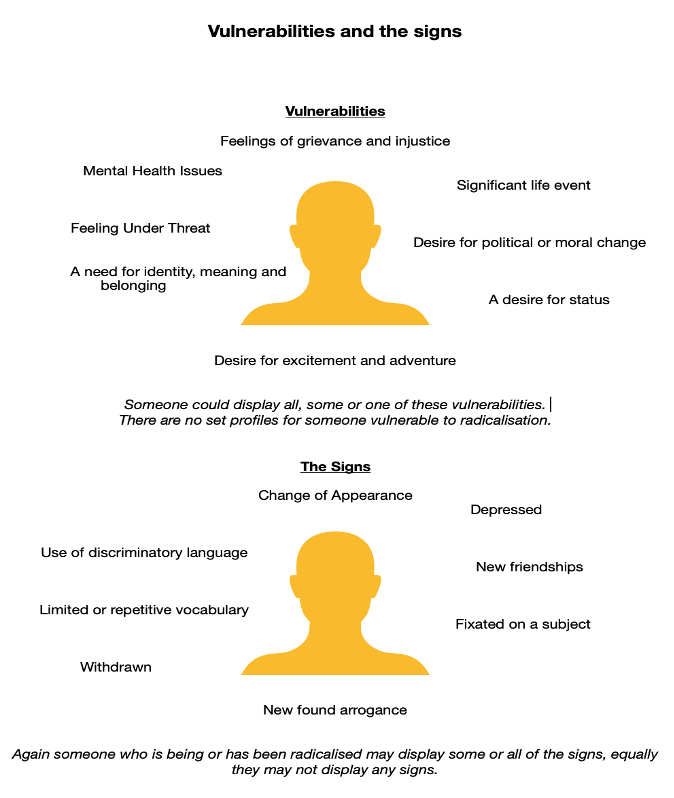
29.3. If you have concerns about an individual who may be vulnerable to being drawn into terrorism, the following questions may help you to quantify and structure your concerns.
29.4. The list of questions is not exhaustive, and other factors may be present, but they are intended as a guide to help communicate your professional judgement about what has led you to make a referral:
29.4.1. Faith/Ideology
• Are they new to a particular faith / faith strand?
• Do they seem to have naïve or narrow religious or political views?
• Have there been sudden changes in their observance, behaviour, interaction or attendance at their place of worship / organised meeting?
• Have there been specific examples or is there an undertone of “Them and Us” language or violent rhetoric being used or behaviour occurring?
• Is there evidence of increasing association with a closed tight knit group of individuals / known recruiters / extremists / restricted events?
• Are there particular grievances either personal or global that appear to be unresolved / festering?
• Has there been an increase in unusual travel abroad without satisfactory explanation?
29.4.2. Personal / emotional / social issues
• Is there conflict with their families regarding religious beliefs / lifestyle choices?
• Is there evidence of cultural anxiety and / or isolation linked to insularity / lack of integration? Is there evidence of increasing isolation from family, friends or groups towards a smaller group of individuals or a known location?
• Is there a history of petty criminality and / or unusual hedonistic behaviour (alcohol / drug use, casual sexual relationships, and addictive behaviours)?
• Have they got / had extremist propaganda materials (DVD’s, CD’s, leaflets etc.) in their possession?
• Do they associate with negative / criminal peers or known groups of concern?
• Are there concerns regarding their emotional stability and / or mental health? Is there evidence of participation in survivalist / combat simulation activities, e.g. paintballing?
29.4.3. Risk / Protective Factors
• What are the specific factors which are contributing towards making the individual more vulnerable to radicalisation? E.g.; mental health, language barriers, cultural anxiety, impressionability, criminality, specific grievance, transitional period in life etc.
• Is there any evidence of others targeting or exploiting these vulnerabilities or risks?
• What factors are already in place or could be developed to firm up support for the individual or help them increase their resilience to negative influences? E.g. positive family ties, employment, mentor / agency input etc.
30. Referrals for VTR concerns
30.1. Referral to children’s social care services should be made using the relevant regional Multi-Agency Referral Form and/or Vulnerable to Radicalisation (VTR) referral form.
30.2. All professionals making telephone referrals to children’s social services must confirm this in writing within 24 hours. If you are worried about the immediate safety of a child/young person and cannot contact a DSL, call the police on 999. You can also contact the relevant local authority.
30.3. Your report must be accurate and where possible use the child’s exact words if they disclosed the information to you, not your own.
30.4. The report must be signed and dated, including the year. Ensure the form is emailed safely following the directions on the form and ensure a copy is sent to Jamma Wellbeing’s DSLs in the same manner marked “Confidential SG”.
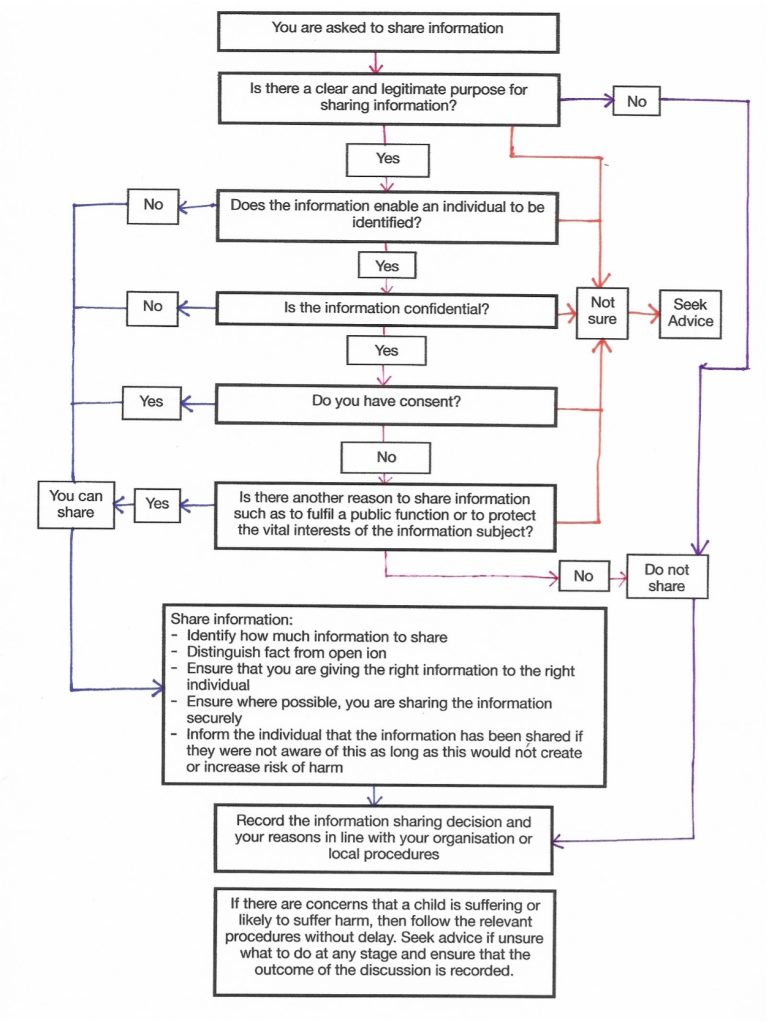
31. Information Sharing Procedures relating to Safeguarding
31.1. Through the safe and effective sharing of information it aims to ensure that adults at risk of abuse and/or children get the support they require from external services and that the people it works with are protected from harm, abuse or neglect. It also seeks to prevent them from offending.
31.2. In many reviews into deaths of children and/adults at risk of abuse the lack of information sharing between agencies and organisations is often highlighted as a contributory, if not causal factor in the death. It is imperative that Jamma Wellbeing trustees, employees, workers and contractors understand the requirement to share safeguarding information in order to protect children from harm.
31.3. Confidentiality and information sharing must be integrated across all aspects of Jamma Wellbeing services and management as its users have the right to privacy and confidentiality and to understand when “secrets” cannot be protected for their best interests.
31.4. Information sharing Definitions
31.4.1. Confidentiality: Not all information is confidential. Confidential information is information of some sensitivity, which is not already lawfully in the public domain or readily available from another public source, and which has been shared in a relationship where the person giving the information understood that it would not be shared with others.
31.4.1.1. Jamma Wellbeing understands confidentiality to mean that no information regarding a service user shall be given directly or indirectly to any third party which is external to the Employees, without that service user’s prior expressed consent to disclose such information.
31.4.2. Breach of confidentiality: Confidence is only breached where the sharing of confidential information is not authorised by the person who provided it or to whom it relates. If the information was provided on the understanding that it would be shared with a limited range of people or for limited purposes, then sharing in accordance with that understanding will not be a breach of confidence. Similarly, there will not be a breach of confidence where there is explicit consent to the sharing.
31.4.2.1. Even where sharing of confidential information is not authorised, Jamma Wellbeing may lawfully share it if this can be justified in the public interest.
31.4.2.2. Seeking consent should be the first option, if appropriate. Where consent cannot be obtained to the sharing of the information or is refused, or where seeking it is likely to undermine the prevention, detection or prosecution of a crime, the question of whether there is a sufficient public interest must be judged by the Organisation based on the facts of each case.
31.4.2.3. Therefore, where you have a concern about a child or young person, you should not regard refusal of consent as necessarily precluding the sharing of confidential information
31.4.3. Public interest: A public interest can arise in a wide range of circumstances, for example, to protect children or other people from harm, to promote the welfare of children or to prevent crime and disorder. There are also public interests, which in some circumstances may weigh against sharing, including the public interest in maintaining public confidence in the confidentiality of certain services. The key factor in deciding whether or not to share confidential information is proportionality, i.e. whether the proposed sharing is a proportionate response to the need to protect the public interest in question.
31.4.4. Serious crime: This means any crime which causes or is likely to cause significant harm to a child or young person or serious harm to an adult.
APPENDIX 1: SAFEGUARDING CODE OF CONDUCT FOR JAMMA WELLBEING TRUSTEES, EMPLOYEES, CONTRACTORS & VOLUNTEERS
1. This Safeguarding Code of Conduct sets out the expectations of Jamma Wellbeing for all Trustees, employees, contractors or volunteers who work for or represent the Organisation in their contact with children, young people and vulnerable adults.
1.1. Failure by any employees member to comply with this Safeguarding Code of Conduct may be considered Gross Misconduct and could end in summary dismissal. Contractors and volunteers may be asked to leave Jamma Wellbeing premises and be dealt with according to the relevant procedures.
2. Do:
2.1. Approach any child, young person or vulnerable adults apparently in distress and ask if you can help seeking assistance from colleagues or supervisors in order to minimise the amount of time you are alone with the individual.
2.2. Be aware of the possible risks and question situations that you find suspicious.
2.3. Actively contribute to an organisational culture where inappropriate behaviour is not tolerated.
2.4. Ensure that whenever possible there is more than one adult present during activities with children, young people and vulnerable adults, or at least that you are within sight or hearing of others.
2.4.1. That could be a colleague, a teacher or a parent/carer.
2.5. If a child, young person or vulnerable adult wishes to talk to you in confidence, then try to find a quiet space in a public area where this is possible.
2.6. Act professionally in all matters and at all times.
2.7. Be aware of what constitutes harassment and especially sexual harassment to ensure avoidance (read Jamma Wellbeing’s internal anti-harassment policies)
2.8. Be aware of appearances and impressions, avoiding any situations which might appear compromising.
2.9. Report any allegation (even if this is just a suspicion) of abuse or inappropriate conduct immediately to Jamma Wellbeing’s DSLs.
2.10. Always do your utmost to accommodate if the child / vulnerable adult at risk expresses a wish to talk to a male or female member of employees.
2.11. Be sensitive in your communications with others to avoid over-familiarity.
2.12. Participate in any training provided by Jamma Wellbeing (or others) and familiarise yourself with all relevant policies and procedures.
3. Do Not:
3.1. Engage in any “rough and tumble” or other horseplay
3.2. Conduct yourself in a manner that could be considered ‘unwelcomed/unwanted’ by the other person
3.3. Make sexually suggestive comments or behave in a manner that could be considered ‘sexual in nature’ towards any visitor/service user (this includes staring, making gestures etc).
3.4. Take or keep photos/videos of children, young people or vulnerable adults on personal phones or other image capture devices
3.5. Use foul or abusive language to any visitor/service user
3.6. Allow or engage in inappropriate touching of any kind
3.7. Give out your personal information, phone numbers, email, or social network site details (e.g., Facebook, Snapchat etc) with any child, young person or vulnerable adult.
33. Undertake things of a personal nature for children or adults at risk that they can do for themselves or that a parent/carer or service provision leader can do / should do for them.
APPENDIX 2: HOW TO REACT WHEN A CHILD/YOUNG PERSON WANTS TO TALK ABOUT ABUSE
1. General points
1.1. Take seriously what the child/young person says (however unlikely the story may sound)
1.2. Keep calm
1.3. Look at the child/young person directly
1.4. Be honest
1.5. Let them know you will need to tell someone else – don’t promise confidentiality
1.6. Reassure them they are not to blame for the abuse
1.7. Be aware that the child/young person may have been threatened
1.8. Never push for information
1.9. Ask questions for clarification only; avoid asking questions that suggest a particular answer
1.9.1. Helpful things to say or show acceptance of what the child/young person says
1.9.1.1. “I am glad you have told me”
1.9.1.2. “It’s not your fault”
1.9.1.3. “I will help you”
1.9.2. Avoid saying
1.9.2.1. “Why didn’t you tell anyone before?”
1.9.2.2. “I can’t believe it”
1.9.2.3. “Are you sure this is true?”
1.9.3. Never make false promises
1.9.4. Never make statements such as “I am shocked!” or “don’t tell anyone else”
1.10. Reassure the young person that they were right to tell you and that you take them seriously.
1.11. Let the young person know what you are going to do next and that you will let them know what might happen. Immediately report the matter, as per procedures.
APPENDIX 3: QUESTIONS TO ASK YOURSELF BEFORE MAKING AN ADULT SAFEGUARDING REFERRAL
1. Are the three safeguarding threshold criteria met?
1.1. Do they have care and support needs?
1.2. Are they experiencing or are at risk of, abuse or neglect?
1.3. As a result of their care and support needs, they are unable to protect himself or herself against the abuse or neglect or the risk of it.
1.3.1. Being safe is only one part of a person’s life. Wellbeing, learning and quality of life are also important factors.
2. What is / are the concern(s)?
2.1. What are the person’s personal preferences and circumstances that create a proportionate tolerance of acceptable risk?
2.2. What would be a proportionate intervention to the potential risk?
2.3. What is/are the vulnerability/ vulnerabilities of the adult?
2.4. What is the nature and extent of the abuse?
2.5. How long has the abuse been occurring?
2.6. What is the impact of the abuse on the individual?
2.7. What is the risk of repeated or increasingly serious acts involving the adult or other adults?
2.8. What is the equality of the relationship between the adult and the alleged abuser? 11. Are there similar allegations against the alleged abuser?
2.9. Is the person safe?
2.10. Do you have consent to share, If not is there an overriding public interest or vital interest to share the information without consent? e.g. Is anyone else at risk? Could a crime have happened/ be about to happen? Is there a high risk to the health and safety of the adult at risk?
3. You must make a referral if:
3.1. The adult considers they are being abused
3.2. The adult is caused distress or there is a deliberate attempt to cause the adult distress
3.3. Incidents are repetitive and targeted
3.4. A crime has been committed
3.5. The incident involves a member of employees
4. Details must be recorded and reported to the relevant local authority’s Adult Safeguarding Coordinator (you may be required to submit a form for this purpose via the authority’s adult safeguarding portal). All appropriate information must be recorded clearly including dates and times when events took place. Facts and opinion should be clearly differentiated.
5. Employees will follow the operational guidance on Making Safeguarding personal as set out in the Multi-agency Safeguarding Policy.
6. This includes the following:
6.1. Seeing people as experts in their own lives and working alongside them in a way that is consistent with their rights and capacity and that prevents abuse occurring wherever possible.
6.2. Person-led and outcome focused safeguarding, engaging the adult at risk in a conversation about how best to respond to their safeguarding situation in a way that enhances involvement, choice and control as well as improving quality of life, wellbeing and safety. Listening to the person and providing options that permit them to help themselves.
6.3. Recognising different preferences, histories, circumstances and lifestyles.
6.4. Wherever possible the adult at risk will decide on the chosen course of action, taking into account the impact of the adult at risk’s mental capacity where relevant. However, employees caring for or assisting them must do everything they can to identify and prevent abuse from happening wherever possible and evidence their efforts.
7. Remember you can discuss your concerns with the DSLs at Jamma Wellbeing as well as the relevant regional MASH professionals consultation service.
APPENDIX 4: RECOGNISING TYPES AND SIGNS OF POSSIBLE CHILD, YOUNG PERSON OR VULNERABLE ADULT ABUSE
The following behavioural types and signs may be indicators of child, young person or vulnerable adult abuse, but care should be taken in interpreting them in isolation.
1. Physical Abuse
1.1. Deliberately hurting an adult, causing injuries such as bruises, broken bones, burns or cuts, or otherwise causing harm. It could also be when a carer fabricates the symptoms of, or deliberately induces illness, or misuses medication.
1.2. Types:
1.2.1. Assault, hitting, slapping, punching, kicking, hair-pulling, biting, pushing
1.2.2. Rough handling
1.2.3. Scalding and burning
1.2.4. Physical punishments
1.2.5. Inappropriate or unlawful use of restraint
1.2.6. Making someone purposefully uncomfortable (e.g. opening a window and removing blankets)
1.2.7. Involuntary isolation or confinement
1.2.8. Misuse of medication (e.g. over-sedation)
1.2.9. Forcible feeding or withholding food
1.2.10. Unauthorised restraint, restricting movement (e.g. tying someone to a chair)
1.3. Possible signs to look out for:
1.3.1. Multiple bruising
1.3.2. Fractures
1.3.3. Injuries in places not normally exposed to falls or rough games
1.3.4. Burns
1.3.5. Bed sores
1.3.6. Fear
1.3.7. Depression
1.3.8. Unexplained weight loss
1.3.9. Assault (can be intentional or reckless)
1.3.10. Failure / refusal to seek medical treatment, or a pattern of visiting different hospitals or doctors over a short period of time.
1.3.11. Changes or regression in mood and behaviour, particularly where a child/young person withdraws or becomes clingy. Also, depression/aggression.
1.3.12. Nervousness or inappropriate fear of particular adults.
1.3.13. Changes in behaviour e.g., under-achievement or lack of concentration, inappropriate relationships with peers and/or adults e.g., excessive dependence / attention-seeking behaviour.
1.3.14. Persistent tiredness, wetting or soiling of bed or clothes by an older child.
1.3.15. Regular poor hygiene
1.3.16. Persistent tiredness
1.3.17. Inadequate clothing
1.3.18. Excessive appetite
1.3.19. Failure to thrive e.g. poor weight gain, consistently being left alone and unsupervised
1.3.20. Any direct disclosure made by a child/young person concerning sexual abuse.
1.3.21. Child/Young person with excessive preoccupation with sexual matters and detailed knowledge of.
1.3.22. Adult sexual behaviour or regularly engaging in age-inappropriate sexual play.
1.3.23. Preoccupation with sexual activity through words, play or drawing.
1.3.24. Child/Young person who is sexually provocative or seductive with adults.
1.3.25. Inappropriate bed-sharing arrangements at home.
1.3.26. Severe sleep disturbances with fears, phobias, vivid dreams or nightmares, sometimes with overt or veiled sexual connotations.
2. Domestic Abuse
2.1. Domestic abuse is any type of violence – or other abuse – that is present in close relationships. For example, it could be between husband and wife; mother/father and their son/daughter; siblings; boyfriend and girlfriend; partner or ex-partner. It can emerge through many other types of abuse: physical, sexual, emotional or financial, and can include undermining of self-confidence and the threat of violence.
2.2. Controlling behaviour is a range of acts designed to make a person subordinate and/or dependent by isolating them from sources of support, exploiting their resources and capacities for personal gain, depriving them of the means needed for independence, resistance and escape and regulating their everyday behaviour.
2.3. Coercive behaviour is an act or a pattern of acts of assault, threats, humiliation and intimidation or other abuse that is used to harm, punish, or frighten their victim.’ (Home Office 2013) Agencies that are concerned that an adult is subject to domestic abuse consider a referral to a multi-agency risk assessment conference (MARAC).
2.4. Action should always be taken to pass on referrals for all incidents of domestic abuse relating to adults at risk. Where the victim is not an adult at risk, concerns should be raised directly with the police.
2.5. The Government definition of domestic abuse, which is not a legal definition, includes so called ‘honour’ based violence, female genital mutilation (FGM) and forced marriage, and is clear that victims are not confined to one gender or ethnic group. Below is a brief outline of Honour Based Violence, FGM and Forced Marriage as outlined in this guide.
2.6. Possible signs to look out for:
2.6.1. Low self-esteem
2.6.2. Physical evidence of violence such as bruising, cuts, broken bones
2.6.3. Verbal abuse and humiliation in front of others
2.6.4. Fear of outside help and support
2.6.5. Damage to home or property
2.6.6. Isolation – not seeing friends and family
2.6.7. Limited access to money
2.6.8. Coercive control / controlling behaviours
3. Sexual Abuse
3.1. Sexual abuse is any sexual activity where a person has been forced or persuaded to take part or doesn’t understand.
3.2. Types:
3.2.1. Rape, attempted rape or sexual assault
3.2.2. Inappropriate touching anywhere on the body
3.2.3. Non- consensual masturbation of either or both persons
3.2.4. Non- consensual sexual penetration or attempted penetration of the vagina, anus or mouth
3.2.5. Any sexual activity that the person lacks the capacity to consent to
3.2.6. Inappropriate looking, sexual teasing or innuendo or sexual harassment
3.2.7. Sexual photography or forced use of pornography or witnessing of sexual acts
3.2.8. Indecent exposure
3.3. Possible signs to look out for:
3.3.1. Bruising, particularly to the thighs, buttocks and upper arms and marks on the neck
3.3.2. Torn, stained or bloody underclothing
3.3.3. Bleeding, pain or itching in the genital area
3.3.4. Repeated urine infections or unexplained stomach pains, soreness or bruising around the genitals, sexually transmitted infections, unplanned, concealed or
3.3.5. denied pregnancies
3.3.6. Uncharacteristic use of explicit sexual language or significant changes in sexual behaviour or attitude
3.3.7. Self-harming
3.3.8. Poor concentration, withdrawal, sleep disturbance
3.3.9. Excessive fear/apprehension of, or withdrawal from, relationships
3.3.10. Fear of receiving help with personal care
3.3.11. Reluctance to be alone with a particular person
4. Emotional Abuse
4.1. Emotional maltreatment. It is sometimes called psychological abuse and can cause serious harm.
4.2. Types:
4.2.1. Isolation from services, social opportunities or friends
4.2.2. Removing mobility of communication aids
4.2.3. Intentionally leaving someone unattended when they need assistance
4.2.4. Preventing expression of choice or opinion
4.2.5. Failure to respect privacy
4.2.6. Preventing stimulation, meaningful occupation or activities
4.2.7. Intimidation, coercion, harassment, use of threats, humiliation, bullying, swearing or verbal abuse
4.2.8. Being patronising or infantilising towards an individual
5. Cyber bullying
5.1. Preventing access to services or support.
5.2. Possible signs to look out for:
5.2.1. An air of silence when a particular person is present
5.2.2. Withdrawal or noticeable changes mood or behaviour
5.2.3. Depression, aggression, extreme anxiety
5.2.4. Signs of distress, tearfulness, anger
5.2.5. Obsessions, fears or phobias
5.2.6. Sleep disorders, changes in appetite
5.2.7. Going missing, stealing and lying
5.2.8. Low self-esteem
6. Financial Abuse
6.1. Financial abuse is the theft or misuse of money, property or personal belongings, taken without consent or under pressure in connection with wills, property or inheritance.
6.2. Types:
6.2.1. Theft of money or possessions
6.2.2. Fraud, scamming
6.2.3. Preventing a person from accessing their own money, benefits or assets
6.2.4. Employees taking a loan from a person using the service
6.2.5. Undue pressure, threat or influence put on the person in connection with loans, wills, property, inheritance or financial transactions
6.2.6. Arranging less care than is needed to save money to maximise inheritance
6.2.7. Denying assistance to manage/monitor financial affairs or access to benefits
6.2.8. Misuse of personal allowance in a care home
6.2.9. Misuse of benefits or direct payments in a family home
6.2.10. Someone moving into a person’s home and living rent free without agreement or under duress
6.2.11. False representation, using another person’s bank account, cards or documents
6.2.12. Exploitation of a person’s money or assets, e.g. unauthorised use of a car
6.2.13. Misuse of a power of attorney, deputy, appointee ship or other legal authority
6.2.14. Rogue trading – e.g. unnecessary or overpriced property repairs and failure to carry out agreed repairs or poor workmanship
6.3. Possible signs to look out for:
6.3.1. Missing personal possessions
6.3.2. Unexplained lack of money
6.3.3. Unexplained withdrawal of funds from accounts
6.3.4. The person allocated to manage financial affairs is evasive or uncooperative
6.3.5. The family or others show unusual interest in the assets of the person
6.3.6. Signs of financial hardship in cases where the person’s financial affairs are being managed by a court appointed deputy or power of attorney
6.3.7. Recent changes in deeds or title to property
6.3.8. Rent arrears and eviction notices
6.3.9. A lack of clear financial accounts held by a care home or service
6.3.10. Failure to provide receipts for shopping or other financial transactions carried out on behalf of the person
6.3.11. Disparity between the person’s living conditions and their financial resources, e.g. insufficient food in the house
6.3.12. Unnecessary property repairs
7. Discriminatory Abuse
7.1. Discriminatory abuse is where an individual is treated differently because of ethnicity, culture, sexuality, gender, age or disability.
7.2. Types:
7.2.1. Verbal abuse, derogatory remarks or inappropriate use of language related to a protected characteristic
7.2.2. Denying access to communication aids, not allowing access to an interpreter, signer or lip-reader
7.2.3. Harassment or deliberate exclusion on the grounds of a protected characteristic
7.2.4. Denying basic rights to healthcare, education, employment and criminal justice relating to a protected characteristic
7.2.5. Substandard service provision relating to a protected characteristic
7.3. Possible signs to look out for:
7.3.1. appearing withdrawn and isolated
7.3.2. expressing anger, frustration, fear or anxiety
7.3.3. evidence that support offered to the individual does not take account their individual needs in terms of a protected characteristic.
8. Neglect
8.1. Neglect is the ongoing failure to meet basic needs. The individual may be left hungry or dirty, without adequate clothing, shelter, supervision, medical/health care, and access to aids or equipment. They may not get the love, care and attention they need from their family or carers.
8.2. Types:
8.2.1. Failure to provide or allow access to food, shelter, clothing, heating, stimulation and activity, personal or medical care
8.2.2. Providing care in a way that the person dislikes
8.2.3. Failure to administer medication as prescribed
8.2.4. Refusal of access to visitors
8.2.5. Not taking account of individuals’ cultural, religious or ethnic needs
8.2.6. Not taking account of educational, social and recreational needs
8.2.7. Ignoring or isolating the person
8.2.8. Preventing the person from making their own decisions
8.2.9. Preventing access to glasses, hearing aids, dentures, etc.
8.2.10. Failure to ensure privacy and dignity
8.2.11. Possible indicators of neglect and acts of omission
8.2.12. Poor environment – dirty or unhygienic
8.2.13. Poor physical condition and/or personal hygiene
8.2.14. Pressure sores or ulcers
8.2.15. Malnutrition or unexplained weight loss
8.2.16. Untreated injuries and medical problems
8.2.17. Inconsistent or reluctant contact with medical and social care organisations
8.2.18. Accumulation of untaken medication
8.2.19. Uncharacteristic failure to engage in social interaction
8.2.20. Inappropriate or inadequate clothing
9. Self-neglect
9.1. Self-neglect is the lack of self-care; lack of care for one’s environment; and/or the refusal of services, to an extent that it threatens personal health and safety.
9.2. Types:
9.2.1. Lack of self-care
9.2.2. Neglecting to care for one’s personal hygiene, health or surroundings
9.2.3. Inability to avoid self-harm
9.2.4. Failure to seek help or access services to meet health and social care needs
9.2.5. Inability or unwillingness to manage one’s personal affairs
9.3. Possible signs to look out for:
9.3.1. Very poor personal hygiene
9.3.2. Unkempt appearance
9.3.3. Lack of essential food, clothing or shelter
9.3.4. Malnutrition and/or dehydration
9.3.5. Living in squalid or unsanitary conditions
9.3.6. Neglecting household maintenance
9.3.7. Hoarding
9.3.8. Collecting a large number of animals in inappropriate conditions
9.3.9. Non-compliance with health or care services
9.3.10. Inability or unwillingness to take medication or treat illness or injury
10. Modern Slavery
10.1. Modern Slavery is where an individual is exploited, forced to work, or sold. It involves the recruitment and movement of individuals using threats, deception and coercion for the purpose of exploitation. Modern Slavery can take many forms:
10.2. Types:
10.2.1. Forced labour
10.2.2. Domestic servitude
10.2.3. Sexual exploitation, such as escort work, prostitution and pornography
10.2.4. Human trafficking
10.2.5. Debt bondage – being forced to work to pay off debts that realistically they never will be able to
10.3. Possible signs to look out for:
10.3.1. Signs of physical or emotional abuse
10.3.2. Appearing to be malnourished, unkempt or withdrawn
10.3.3. Isolation from the community, seeming under the control or influence of others
10.3.4. Living in dirty, cramped or overcrowded accommodation and or living and working at the same address
10.3.5. Lack of personal effects or identification documents
10.3.6. Always wearing the same clothes
10.3.7. Avoidance of eye contact, appearing frightened or hesitant to talk to strangers
10.3.8. Fear of law enforcers
11. Organisational Abuse
11.1. Organisational abuse is where poor working practices in special education establishments, care homes or hospitals cause mistreatment by repeated poor or inadequate care, which violates a person’s dignity and human rights.
11.2. Types:
11.2.1. Discouraging visits or the involvement of relatives or friends
11.2.2. Run-down or overcrowded establishment
11.2.3. Lack of leadership and supervision
11.2.4. Insufficient employees or high turnover resulting in poor quality care
11.2.5. Abusive and disrespectful attitudes towards people using the service
11.2.6. Inappropriate use of restraints
11.2.7. Lack of respect for dignity and privacy
11.2.8. Not providing adequate food and drink, or assistance with eating
11.2.9. Not offering choice or promoting independence
11.2.10. Misuse of medication
11.2.11. Failure to provide care with dentures, spectacles or hearing aids
11.2.12. Not taking account of individuals’ cultural, religious or ethnic needs
11.2.13. Failure to respond to abuse appropriately
11.2.14. Interference with personal correspondence or communication
11.2.15. Failure to respond to complaints
11.3. Possible signs to look out for:
11.3.1. Lack of flexibility and choice for people using the service
11.3.2. Inadequate staffing levels
11.3.3. People being hungry or dehydrated
11.3.4. Poor standards of care
11.3.5. Lack of personal clothing and possessions and communal use of personal items
11.3.6. Lack of adequate procedures
11.3.7. Poor record-keeping and missing documents
11.3.8. Absence of visitors
11.3.9. Few social, recreational and educational activities
11.3.10. Public discussion of personal matters
11.3.11. Unnecessary exposure during bathing or using the toilet
11.3.12. Absence of individual care plans
11.3.13. Lack of management overview and support
12. Honour Based Violence (HBV)
12.1. Honour Based Violence (HBV) is a crime or incident which has or may have been committed to protect or defend the honour of the family or community. It is a collection of practices used to control behaviour within families or other social groups, to protect perceived cultural and religious beliefs and/or honour. Such violence can occur when a relative has shamed the family and/or community by breaking their honour code.
12.2. Women are predominately but not exclusively the victims of so-called HBV which is used to assert male power in order to control female autonomy and sexuality. Honour Based Violence can be disguised from other forms of violence as it is often committed with some degree of approval and/or collusion from family and/or community members. Such crimes cut across all cultures, nationalities, faith groups and communities and should be referred within existing adult protection procedures where the victim is an ‘adult at risk’ as defined by the Care Act 2014.
12.3. Where children or adults at risk are identified as being victims of, involved in, or witness to Honour Based Violence, contact should be made with the relevant regional Child or Adult safeguarding teams. Victims of Honour Based Violence can also access help and advice from Karma Nirvana at www.karmanirvana.org.uk or by contacting 0800 5999247.
13. Forced Marriage
13.1. A forced marriage is where one or both people do not (or in cases of people lacking the mental capacity to make the relevant decisions, cannot) consent to the marriage and pressure or abuse is used. Forced marriage is recognised in the UK as a form of violence against women and men, domestic/child abuse and a serious abuse of human rights.
13.2. The pressure put on people to marry against their will can be physical (including threats, actual physical violence and sexual violence) or emotional and psychological (for example, when someone is made to feel like they are bringing shame on their family). Financial abuse (removal of wages or deprivation of finances or necessities) can also be a factor.
13.3. All Forced Marriage alerts relating to adults at risk are to be submitted to the Safeguarding Lead within the relevant regional authority.
13.3.1. Further support can be accessed via the Forced Marriage Unit (FMU). The FMU is a joint Foreign and Commonwealth Office and Home Office unit which was set up in January 2005 to lead on the Government’s forced marriage policy, outreach and casework. It operates both inside the UK, where support is provided to any individual, and overseas, where consular assistance is provided to British nationals, including dual nationals. The FMU operates a public helpline to provide advice and support to victims of forced marriage as well as to professionals dealing with cases. The assistance provided ranges from simple safety advice, through to aiding a victim to prevent their unwanted spouse moving to the UK (‘reluctant sponsor’ cases), and, in extreme circumstances, to rescue victims held against their will overseas. Tel: +44 (0) 20 7008 0151.
13.4. Victims of Forced Marriage can also access help and advice from Karma Nirvana at www.karmanirvana.org.uk or by contacting 0800 5999247.
13.5. It is important to remember the following when addressing issues of Forced Marriage and/or Honour-based violence:
13.5.1. DO NOT go directly to share information with, or use as an interpreter, a relative (including any children present), friend, neighbour, community leader or other with influence in the community. This will alert them to your enquiries and may place the adult at further risk.
13.5.2. DO NOT attempt to give the person immigration advice. It is a criminal offence for any unqualified person to give this advice.
14. Female Genital Mutilation (FGM)
14.1. Female genital mutilation/ FGM (sometimes referred to as female circumcision) refers to procedures that intentionally alter or cause injury to the female genital organs for non-medical reasons. The practice is illegal in the UK. Girls under the age of 15 are mainly at risk but it is important for everyone working with adults at risk to be mindful of this practice and refer any concerns to the relevant regional safeguarding team within the local authority. If they believe that the adult or a child within the family may be at risk of FGM the police and health colleagues will be notified in the Multi-Agency Safeguarding Hub.
15. Psychological Abuse
15.1. Psychological, or emotional abuse, includes the use of threats, fears or bribes to negate an adult at risk’s choices, independent wishes and self-esteem; cause isolation or overdependence (as might be signalled by impairment of development or performance); or prevent an adult at risk from using services, which would provide help.
15.2. Possible signs to look out for:
15.2.1. Ambivalence about carer
15.2.2. Fearfulness expressed in the eyes, avoids looking at the carer, flinching on approach
15.2.3. Deference
15.2.4. Overly affectionate behaviour to alleged source of risk
15.2.5. Insomnia/sleep deprivation or need for excessive sleep
15.2.6. Change in appetite
15.2.7. Unusual weight gain/loss
15.2.8. Tearfulness
15.2.9. Unexplained paranoia
15.2.10. Low self-esteem
15.2.11. Excessive fears
15.2.12. Confusion
15.2.13. Agitation
16. Crime and Anti-Social Behaviour
16.1. Antisocial behaviour is any aggressive, intimidating or destructive activity that damages or destroys another person’s quality of life; defined by the Crime and Disorder Act 1998 as ‘acting in a manner that caused or was likely to cause harassment, alarm or distress to one or more persons not of the same household as the defendant’.
17. Disclosure and Barring Service (DBS)
17.1. The Safeguarding Vulnerable Groups Act 2006 (SVGA) places a legal duty on employers in the health and social care sector and personnel suppliers to refer any person to the Disclosure and Barring Service who has:
17.1.1. Harmed or poses a risk of harm to a child or adult at risk of abuse.
17.1.2. Satisfied the harm test; or
17.1.3. Received a caution or conviction for a relevant offence.
17.2. Practitioners are therefore advised to check that a DBS referral has been submitted where any employee named as the alleged abuser is dismissed as a result of their conduct or resign prior to the conclusion of a Section 42 Enquiry.
17.3. For further information, please refer to the Safeguarding Adults Board policy on Regulated Services.
18. Abuse of Employee by Service Users
18.1. Although abuse of employees by service users or other employees is a very serious matter which requires immediate action, the Safeguarding Adults policy is not appropriate to address this situation.
18.2. In these circumstances, employees should be assisted via the Organisation’s internal HR (Human Resources) procedures.
18.3. Appropriate intervention can also be sought for the service user, such as referral for an unscheduled review by the area cluster or assessment by a health professional.